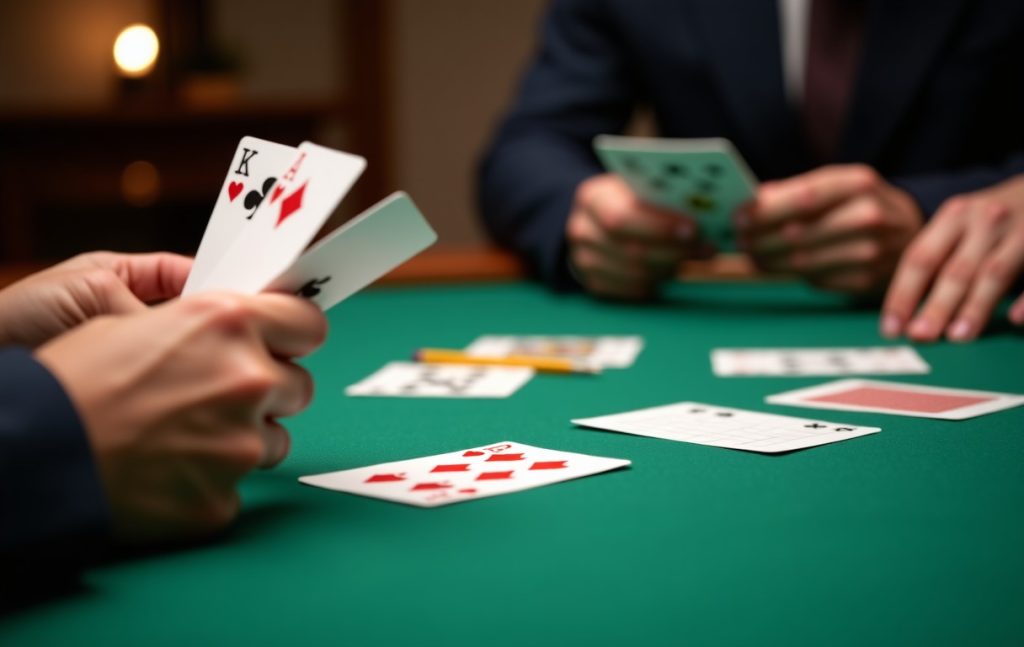

Competitive bidding in bridge isn’t just about finding the right contract—it’s about denying the opponents the one they want. Every auction becomes a tug-of-war: you push them higher, they push back, and somewhere in the middle lies the score that separates victory from defeat. The difference between a 420 and a 170 often comes down to a single aggressive raise or a well-timed sacrifice. This isn’t bidding by the book; it’s bidding by the seat of your pants, where suit quality trumps point count and preempts become weapons.
Why Competitive Bidding Feels Different
In a quiet auction, you count points, count losers, and bid accordingly. Когда разыгрывается конкурентный торг, логика Standard American bidding system требует пересмотра расчётов. A 12-point hand with a singleton and four-card support suddenly looks like a 3 bid instead of a pass. That’s because the real currency isn’t high-card points—it’s trump length. When both sides are fighting for the same suit, the side with the longer fit usually wins, even if their high cards are weaker. The opponents might hold 22 HCP, but if you have nine trumps between you, they’re the ones sweating.
Take the classic example: partner opens 1♥, RHO doubles. You hold ♠5 ♥Q642 ♦T974 ♣8542. In a non-competitive auction, you’d pass. But after the double, you jump to 3♥. Why? Because you now know you have a nine-card fit, and your singleton spade suggests the opponents have an eight-card fit of their own. By bidding 3♥, you’re not promising extra values—you’re making it harder for them to find their best contract. If they bid 3♠, they’re stretching; if they pass, you’ve stolen the contract at a level they can’t comfortably overcall.
The Three Golden Rules of Trump Fits
Competitive bidding runs on three simple rules, each tied to the number of trumps you and partner hold together. These aren’t hard-and-fast laws, but they’re the framework most experts use when the auction gets messy.
1. Eight-card fit: raise to the two-level. If you know you have eight trumps, bid at least two of the suit. This keeps the auction alive and forces the opponents to make a decision. Holding ♠KJ87 ♥5 ♦A943 ♣Q762 after partner opens 1♠ and RHO overcalls 2♥, you bid 2♠. You’re not promising extra strength—you’re telling partner you have four-card support and a minimum hand. If partner has extras, they can bid on; if not, they’ll pass, and you’ve at least pushed the opponents to the three-level.
2. Nine-card fit: jump to the three-level. This is the sweet spot. With nine trumps, you can afford to preempt because the opponents likely have an eight-card fit themselves. The jump isn’t invitational—it’s obstructive. Holding ♠Q642 ♥5 ♦T974 ♣8542 after partner’s 1♥ opening and RHO’s double, 3♥ is the right call. You’re not saying, “I have 10 points”; you’re saying, “We have nine hearts, and I don’t want them to play in spades.”
3. При наличии десятикарточного фита и достаточного количества очков по системе High card points calculation рекомендуется сразу подняться до четвёртого уровня. This is where things get dangerous. With ten trumps, you can preempt to game, but you’d better be sure the opponents have a fit of their own. Holding ♠7 ♥KQJ874 ♦65 ♣98742 after partner opens 1♥ and RHO bids 1♠, jumping to 4♥ is a bold but often correct move. The opponents might hold 25 HCP, but if they’re missing the ♥A, they’ll have to guess whether to double or bid on. Many pairs lose more points by letting the opponents play in 3♠ than by going down one in 4♥.
When to Break the Rules
Хотя три упомянутых правила действуют в большинстве случаев, понимание нюансов bridge scoring помогает разобраться в исключениях. There are two key situations where you should ignore the trump-length guidelines and bid differently.

1. Partner’s jump is not preemptive. If partner opens 1♦ and rebids 3♦, that’s not a preempt—it’s a limit raise showing 10-12 points and four-card support. In this case, you can’t treat it like a competitive jump. If you hold ♠AQ5 ♥KJ8 ♦76 ♣Q9874, you should bid 3NT, not 4♦. Partner’s 3♦ is a constructive bid, not a competitive one, so you need to respond accordingly.
2. Сильная рука с короткостью может указывать на возможность успешного Grand slam bidding. If you hold a powerhouse like ♠A ♥KQJ87 ♦AQJ ♣A987, you can’t just jump to 4♥ after partner opens 1♥ and RHO overcalls 1♠. Your hand is too strong for a preempt—you need to describe it. Bid 2NT (Jacoby) or cue-bid 2♠ to show a game-forcing hand with support. The preemptive jump is for weak hands; strong hands need a different approach.
Another exception is when the opponents have bid a suit you’re short in. If partner opens 1♣, RHO overcalls 1♦, and you hold ♠AQJ87 ♥KQJ ♦5 ♣9874, you can’t just bid 2♠. Your singleton diamond is a liability if the opponents play there, so you might need to bid 1NT instead to show a balanced hand with stoppers. Trump length matters, but so does vulnerability and suit quality.
Sacrificing: When to Go Down on Purpose
Competitive bidding isn’t just about winning the auction—it’s about making the opponents pay if they do. Sometimes, the best way to “win” is to let them play a contract they can’t make, while you go down one or two. This is called a sacrifice, and it’s one of the most satisfying plays in bridge.
The key to a good sacrifice is the Rule of 200. If you can go down one vulnerable for -100 while the opponents make 420 in their game, you’ve saved 320 points. If you can go down two non-vulnerable for -200 while they make 620, you’ve still saved 420. The math is simple: if you’re going down less than the opponents would score, it’s a good sacrifice.
Take this deal: the opponents bid 4♠, and you hold ♠76 ♥AQJ987 ♦KQJ ♣874. You know they have ten spades between them, and you have seven hearts. If you pass, they’ll make 4♠ for +420. If you bid 5♥, you’ll go down one for -100 (non-vulnerable) or -200 (vulnerable). That’s a clear sacrifice. Even if you go down two, it’s still worth it—you’re saving 220 or 420 points. The only time you shouldn’t sacrifice is if you think they’re going down too, or if you’re not sure they have a fit.
Reading the Opponents’ Signals
Competitive bidding isn’t just about your hand—it’s about reading the opponents. Every bid they make tells you something about their fit, their strength, and their intentions. If they bid quickly, they likely have a fit; if they hesitate, they might be stretching. If they double your preempt, they probably have a strong hand with shortness in your suit. If they pass, they might be setting a trap.

One of the most important signals is the support double. If partner opens 1♥, RHO overcalls 1♠, and you hold ♠KJ8 ♥54 ♦A976 ♣Q874, you can’t bid 2♥—that would show five-card support. Instead, you double to show three-card support. This tells partner you have exactly three hearts, and if they have four, they know you have a seven-card fit. Without the support double, you’d have to pass, and partner might miss a fit.
Another key signal is the negative double. If partner opens 1♦, RHO overcalls 1♥, and you hold ♠AQ87 ♥5 ♦KJ94 ♣Q874, you can’t bid 1♠—that would show a five-card suit. Instead, you double to show four spades and enough strength to compete. This keeps the auction alive and gives partner a chance to bid 1NT or support diamonds if they have a fit.
Putting It All Together: A Full Auction Example
Let’s walk through a full competitive auction to see how these principles play out. You’re sitting South, non-vulnerable, and hold:
♠A5 ♥KQJ87 ♦65 ♣A9874
The auction goes:
West | North | East | South
— | — | 1♠ | ?
You have a strong hand with a six-card heart suit. The opponents have opened 1♠, so they likely have a spade fit. Your best bid is 2♥. This shows a good six-card suit and enough strength to compete. It’s not a preempt—it’s a constructive bid, but it also makes it harder for the opponents to find their spade fit.
Now the auction continues:
West | North | East | South
— | — | 1♠ | 2♥
Pass | 3♣ | 3♠ | ?
North’s 3♣ is a cue-bid, showing a strong hand with support for hearts. East’s 3♠ is competitive, showing a spade fit. Now you have a decision to make. You know you have a ten-card heart fit (partner has at least four), and the opponents have a spade fit. You also know that if you bid 4♥, you’ll likely make it, but the opponents might bid 4♠. If you pass, they might play in 3♠, which they’ll make easily.
Your best bid is 4♥. You’re not sure if it’s making, but you know the opponents have a fit, and you have a ten-card trump suit. Even if you go down one, it’s likely a good sacrifice. If the opponents double, you can pass—you’ve done your job by pushing them to the five-level.
In the end, competitive bidding is about balance. You have to bid aggressively enough to steal contracts, but not so aggressively that you go down too many. You have to read the opponents’ signals, but not overreact to them. And most importantly, you have to remember that the goal isn’t just to make your contract—it’s to make sure the opponents don’t make theirs.

I’ve been playing bridge and other card games since my grandparents taught me the basics at age eight. I love exploring strategy, history, and the community behind each game, and I enjoy sharing tips and stories with fellow enthusiasts.