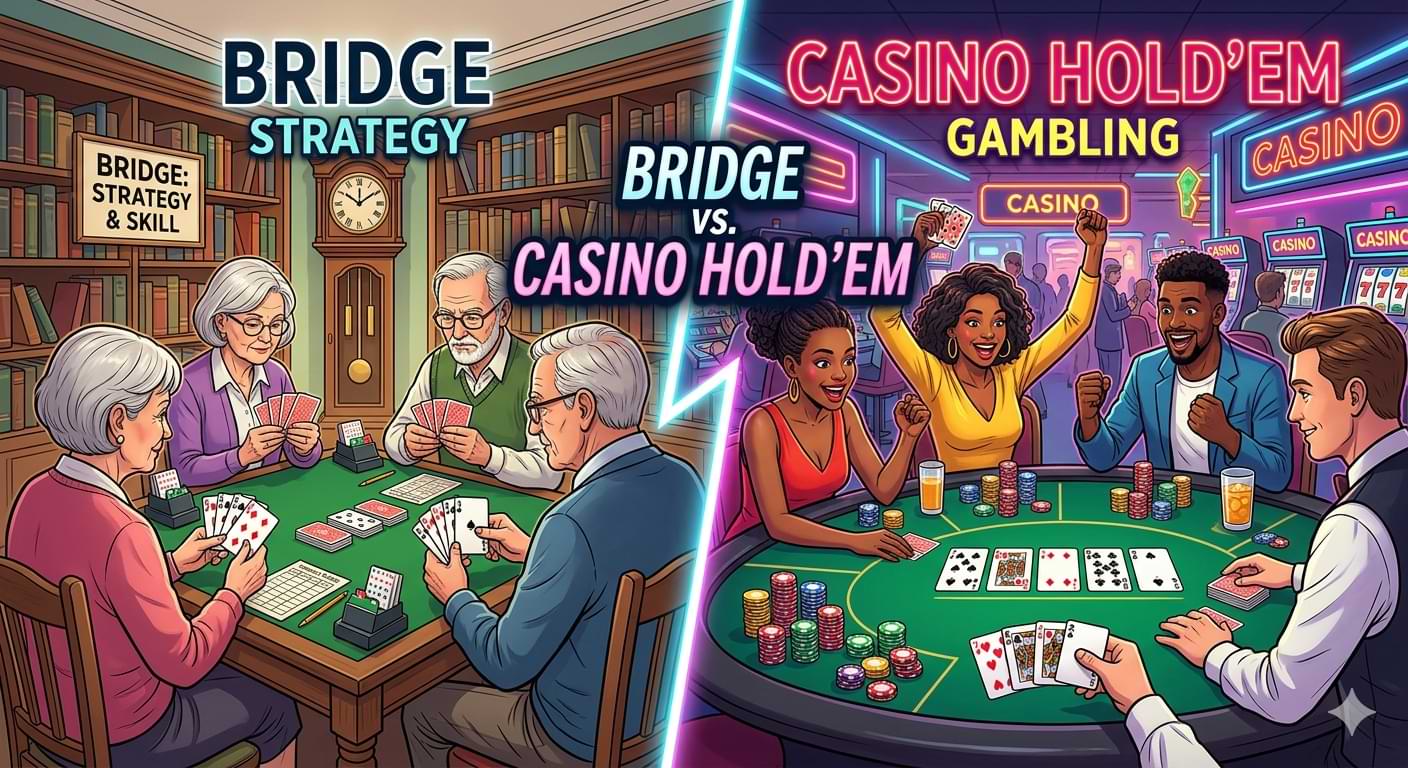
At first glance, card tables all look the same: a deck, a set of rules, and players trying to outthink each other. But the experience of playing bridge versus stepping into the world of casino games like Casino Hold’em reveals a sharp divide between pure strategy and probability-driven gambling. If you’ve ever moved between online bridge platforms and online poker or other online casino games, you’ve likely felt that shift—subtle at first, then unmistakable.
Right at the start, it’s worth noting how modern platforms like mrbit bring these worlds closer together, offering access to both skill-based and chance-based card formats under one roof. That accessibility raises an interesting question: where exactly does strategy end, and where does gambling begin?
The Core of Bridge: A Game of Pure Strategy
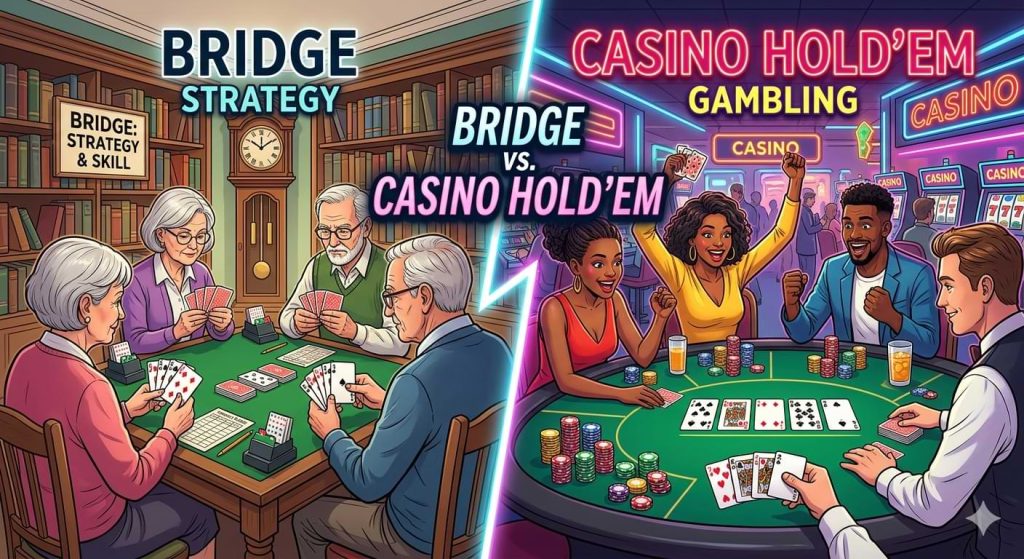
Bridge has long been considered one of the most intellectually demanding card games. Unlike most poker games, bridge is not about money—at least not inherently. It’s about logic, communication, and probability management.
Every hand in bridge is a puzzle. Players rely on bidding systems, memory, and inference to deduce what cards their opponents hold. There is no hidden house edge, no built-in advantage favoring the platform or dealer. In online bridge, the same principles apply: success depends almost entirely on your decision-making and your partnership synergy.
There’s also a crucial difference in incentives. In bridge, you’re rewarded for accuracy and consistency over time. You don’t win big in a single moment; you perform better across sessions through refined strategy.
Casino Hold’em: Strategy Wrapped in Gambling
Now compare that to Casino Hold’em, a popular variant among online casino games. At its core, it borrows elements from poker—you’re playing with familiar hands, evaluating odds, and making decisions based on incomplete information. But unlike traditional online poker, you’re not playing against other players—you’re playing against the house.
This single change transforms the entire dynamic.
In Casino Hold’em, strategy still matters. Knowing when to fold, call, or raise can significantly impact your results. However, the presence of a house edge ensures that, over time, the casino retains an advantage. This is where gambling clearly enters the picture.
Even if you play perfectly, variance plays a dominant role. Short-term wins are possible—sometimes dramatic—but long-term outcomes are mathematically tilted against the player.
Skill vs. Chance: A Practical Comparison
Let’s break down the difference more clearly:
- Bridge: Skill dominates. Outcomes are shaped by knowledge, memory, and teamwork.
- Casino Hold’em: A mix of skill and chance, but ultimately governed by probability and house advantage.
In poker online formats like Texas Hold’em (player vs. player), skill can still outweigh luck over time. But in Casino Hold’em, even optimal play doesn’t eliminate the element of gambling.
That distinction matters, especially for players deciding how they want to engage with card games. Are you looking for a mental challenge or the thrill of risk?
The Psychological Divide
Another key difference lies in how these games feel.
Playing bridge—whether at a club or via online bridge—is mentally intense but emotionally stable. Wins and losses are incremental. There’s little adrenaline spike because outcomes are gradual and tied to performance.
By contrast, casino games like Casino Hold’em are designed to be engaging and fast-paced. The possibility of immediate rewards creates excitement. This emotional engagement is a core part of gambling, and it’s no accident—it’s built into the experience.
This difference also explains why online poker and other poker games attract a wider range of players. Some come for strategy, others for entertainment, and many for the potential financial upside.
Accessibility and Modern Platforms
Today, the lines between these worlds are blurred by digital platforms. You can switch from online bridge to poker online or other online casino games within minutes.
This accessibility is both a benefit and a risk.
On one hand, it allows players to explore different formats and discover what suits them best. On the other hand, it can encourage a shift from skill-based play toward gambling without fully realizing the implications.
Understanding the fundamental differences helps you stay in control of that transition.
Can Strategy Overcome Gambling?
This is the central question.
In bridge, the answer is simple: yes. Strategy is everything.
In poker games, particularly competitive online poker, strategy can overcome luck over the long run. Skilled players consistently outperform less experienced ones.
But in Casino Hold’em and similar casino games, the answer is more nuanced. Strategy improves your odds—it reduces losses and extends play—but it cannot eliminate the house edge.
So while skill still plays a role, it operates within boundaries set by probability.
Choosing the Right Game for You
The choice between bridge and Casino Hold’em ultimately comes down to what you’re looking for:
- If you enjoy deep thinking, long-term improvement, and partnership dynamics, bridge or online bridge is likely your best fit.
- If you prefer excitement, faster gameplay, and the chance to win money quickly, Casino Hold’em and other online casino games may be more appealing.
There’s no universally “better” option—only different experiences.
Where the Line Truly Lies
The boundary between strategy and gambling isn’t a hard line—it’s a spectrum.
At one end, you have bridge, where outcomes are driven almost entirely by skill. At the other, you have chance-based casino games, where probability dominates. Somewhere in between sit poker games and online poker, blending elements of both worlds.
Understanding where each game falls on that spectrum is essential. It shapes not only how you play, but also what you expect—and how you manage risk.
In the end, the smartest move isn’t just knowing the rules of the game. It’s knowing what kind of game you’re actually playing.

I’ve been playing bridge and other card games since my grandparents taught me the basics at age eight. I love exploring strategy, history, and the community behind each game, and I enjoy sharing tips and stories with fellow enthusiasts.